Subaru FA24D Investigation
The Subaru FA24D Oil Starvation Issue — Why It Matters and How You Can Help Wade Kilpela Slade’s Investigation
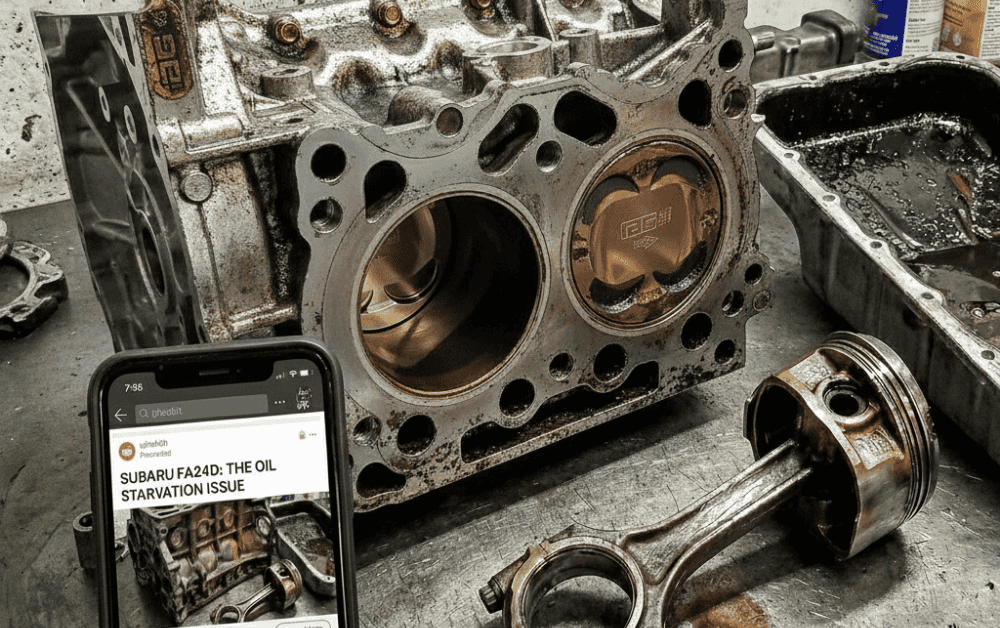
Subaru Oil Starvation
Subaru’s FA24D engine — the 2.4-liter naturally aspirated flat-four found in the latest BRZ and Toyota GR86 — has earned praise for its torque, responsiveness, and overall driving character. But over the past few years, a recurring topic within the enthusiast community has cast a shadow over that reputation: oil starvation issues under high-load conditions. What began as scattered reports from track enthusiasts has grown into a pattern that warrants serious attention from owners, tuners, mechanics, and everyday drivers alike.
This blog explains the FA24D oil starvation phenomenon and invites FA24D owners — especially those who track their cars or have diagnostic data — to participate in Wade’s survey. Your responses will help build the most comprehensive picture yet of this issue.
What Is Oil Starvation?
Oil starvation means the engine’s oil pump is momentarily drawing air instead of oil. In an internal combustion engine, continuous lubrication is critical: oil reduces friction, carries heat away, and protects bearings and journals from metal-to-metal contact. If the pump doesn’t have a steady supply of oil — even for fractions of a second — pressure drops and sensitive components can be damaged.
In most engines, the oil pan and pickup are designed to keep oil available even during aggressive driving. But the FA24D’s boxer configuration — with its flat layout and oil pan geometry — can allow oil to “slosh” away from the pickup during hard cornering, aggressive acceleration, or severe braking. This issue is not unique to Subaru — flat engines in general have more complex oil control challenges than inline or V-configured units — but the FA24D has become a focal point because of real reports of pressure loss and resulting failures.
How and Why It Happens
The FA24D’s oiling system has several characteristics that contribute to potential starvation:
- Flat Engine Geometry: The horizontally opposed layout means oil can accumulate in the cylinder heads and away from the pan’s pickup, especially during long sustained lateral loads.
- Minimal Baffling: The factory oil pan has modest baffling. Under extreme G-forces, oil can slosh out of the pickup’s reach.
- High Oil Pump Flow: The FA24D’s pump moves a lot of oil at high RPM, but if the supply isn’t near the pickup, that volume becomes irrelevant.
- Oil Pickup Screen Clogging: In a number of documented cases, excess assembly sealant (RTV) used during manufacturing has broken off and lodged in the pickup screen, blocking flow.
These factors can interact. For example, a blocked pickup screen will starve the engine even on the street; significant lateral forces can induce starvation on track; and a combination of both can result in catastrophic bearing failure.
Documented Instances and Community Reports
Over the last few years, owners have reported instances where engines have failed after what seemed like otherwise normal use. In some cases, teardown confirmed blocked oil pickup screens — often clogged with sealant debris — as the culprit. In other instances, data logs from track days showed oil pressure plunging into unsafe territory during sustained cornering.
These reports are not fringe anecdotes; independent shops have encountered multiple blocked pickup cases, and several owners have documented their experiences publicly with videos, photos, and teardown reports. Various online threads, social platforms, and group discussions have built up a body of evidence suggesting that this is not a one-off event.
Why This Matters
If you own a Subaru with the FA24D engine — understanding the oiling behavior of your engine is vital. If certain driving styles or conditions are correlated with oil pressure dips, you should know. If some engines exhibit oil pickup obstruction, owners need to be aware. If OEM oiling provisions are marginal at high loads, solutions — whether aftermarket modifications or factory revisions — must be pursued.
What You Can Do
Your participation matters. Whether you’ve experienced problems, have detailed logs, or just want to contribute to a better understanding of your engine’s behavior, your input strengthens the community’s knowledge base.
Fill out the form if you have had issues with your 2022+ FA24D engine and oil starvation.